
If you’ve ever booked a facial hoping for clear, glowing skin-only to see the results fade in a couple of days-you’re not alone. With so many options today, the confusion between Hydrafacial and traditional facials is real.
They may sound similar and even look similar in advertising, but they work very differently on your skin.
One focuses on pampering, the other is a medical-grade treatment powered by technology.
And in 2025, Hydrafacial has become the global favourite for people in their 20s because it’s painless, fast, customizable, and incredibly effective. Let’s break down the real difference in a detailed yet simple way.
Now, let’s walk through both treatments as if your skin were the protagonist.
The Real Difference:
1. Step-by-Step Experience
Traditional Facial:
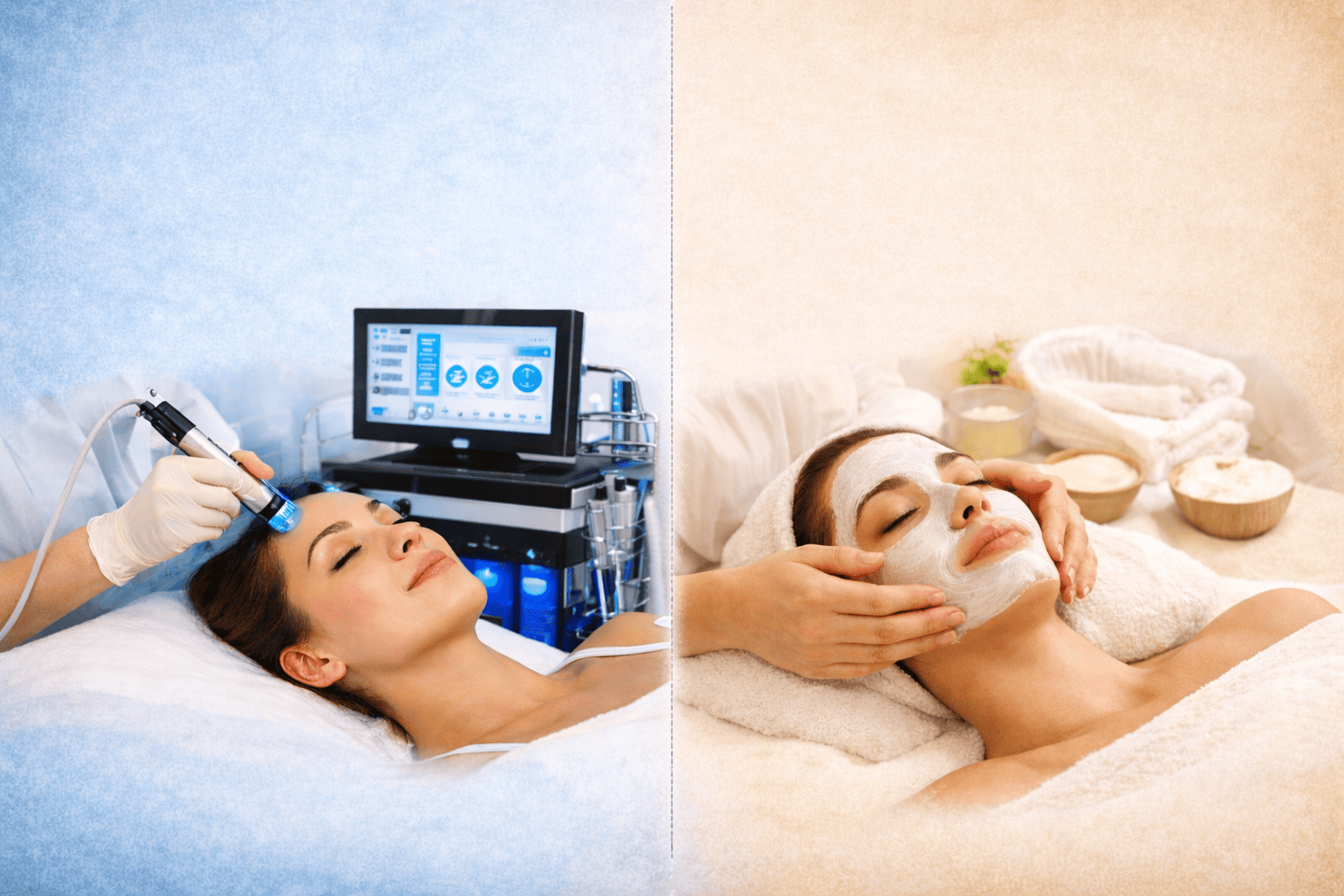
Your skin goes through a sequence-steam, exfoliation, cream massage, and extraction. It’s soothing, relaxing, and sensory. But it often depends heavily on the therapist’s manual skills and choice of products.
Hydrafacial:
A Hydrafacial tells a different story. A patented device moves across your skin, using vortex suction to exfoliate, extract impurities, and infuse serums-all in one automated workflow.
No pain, no redness (usually), and consistent results.
You experience:
- Cleanse
- Gentle acid peel
- Vacuum suction removal of blackheads
- Hydration infusion
- Antioxidant protection
Your skin feels “reset” at a structural level rather than just polished.
2. How Deep Each Treatment Goes
Traditional facials work only on the epidermis-the top layer.
They improve temporarily:
- Softness
- Glow
- Relaxation
But Hydrafacial works on a deeper level of skin health, affecting:
- Congestion inside pores
- Hydration levels in deeper layers
- Early collagen breakdown
- Circulation and nutrient delivery
This is why your Hydrafacial glow stays longer-because it is driven by physiology, not cosmetics.
3. Suitability for Different Skin Types
Traditional facials may irritate sensitive or acne-prone skin because they use thicker creams and manual extractions.
Hydrafacial is ideal for:
- Acne-prone skin
- Dull or dehydrated skin
- Sensitive skin
- Pigmentation
- Textural irregularities
- Early signs of aging
It’s designed to be gentle yet effective-rare combination.
4. Customization Options (The 2026 Advantage)
Hydrafacial machines today work like modular skincare systems. Dermatologists can choose boosters based on what your skin needs most:
- Anti-acne boosters if you’re dealing with breakouts
- Pigment correction boosters for tanning or dark spots
- Collagen-boosting peptides for early aging
- Extra hydration serums for dehydrated skin
Traditional facials cannot offer this level of personalization.
5. Results You Can Expect
The contrast becomes clear when you compare longevity:
- A traditional facial gives glow for 2–3 days.
- A Hydrafacial gives glow for 7–14 days and improves long-term skin quality with repeated sessions.
Hydrafacial also reduces blackheads, tightens pores, improves smoothness, and enhances brightness over time.
6. Why Dermatologists Prefer Hydrafacial
Dermatologists recommend Hydrafacial because it complements medical treatments like peels, acne therapies, laser toning, and pigment correction. Since the device is standardized, it eliminates human inconsistencies, ensuring safety and predictable results.
Hydrafacial doesn’t just clean-it improves the skin’s ability to repair itself.
Conclusion:
If you’re unsure which facial suits your skin best, it’s time to switch from guesswork to guided care.
At Welona, dermatologists study your skin deeply before recommending any treatment, ensuring you get the version of Hydrafacial or facial that actually works for you.
Book your consultation and experience what expert-led skincare truly feels like.