Red light therapy, also known as Low-Level Laser Therapy (LLLT) or photobiomodulation, uses specific wavelengths of red and near-infrared light to stimulate hair follicles, prolong the hair growth phase, and improve hair density. Clinical evidence from multiple randomised controlled trials and a 2025 PMC systematic review confirms that LLLT significantly improves hair density in androgenetic alopecia in both men and women. It is FDA-cleared for hair loss and is considered a legitimate, evidence-backed adjunct treatment. However, it is not a standalone solution for significant hair loss and works best when combined with other clinical treatments like GFC, PRP, or medical therapy. Home devices deliver weaker results than clinical-grade systems.
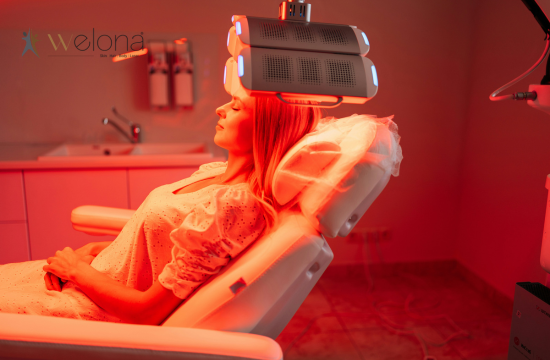
Red Light Therapy for Hair Growth: Does It Really Work?
Red light therapy for hair growth has gone from a fringe wellness trend to a clinically researched treatment option in a relatively short period of time. You’ve probably seen it marketed everywhere, from handheld devices on Amazon to dedicated helmet-shaped gadgets promising to regrow your hair at home. Some of it is genuine. Some of it is not.
This blog cuts through the noise with a clear, honest look at what red light therapy is, what the science actually shows about whether it works, its limitations, and how it fits into a broader hair loss treatment plan at Welona.
What Is Red Light Therapy and How Does It Work on Hair?
Red light therapy uses specific wavelengths of light, typically 630-670 nanometres in the red spectrum, to penetrate the skin and interact with cells at a biological level. In the context of hair growth, this light is absorbed by mitochondria in hair follicle cells, triggering a cascade of cellular activity.
In simpler terms, light energy acts like a biological switch, waking sluggish or weakened follicles and encouraging them to shift from the resting phase back into the active growth phase.
The key mechanisms through which LLLT supports hair growth are:
- Extending the anagen (growth) phase of the hair cycle so that follicles spend more time actively producing hair
- Improving blood flow to the scalp, which means better nutrient and oxygen delivery to follicle cells
- Reducing scalp inflammation, which is an often-overlooked driver of follicle miniaturisation
- Stimulating cellular energy production (ATP) in follicle cells, making them more metabolically active and responsive
This is not the same mechanism as GFC or PRP, which deliver growth factors directly into the follicle. Red light therapy works through a photobiological pathway rather than a biochemical one, which is why it complements rather than replaces other treatments.
What Does the Research Say?
Unlike many viral hair growth trends, Red Light Therapy has been studied in clinical research. Several studies have reported improvements in hair density and hair thickness among patients with androgenetic alopecia after consistent use of Low-Level Laser Therapy.
A systematic review published in Lasers in Medical Science concluded that LLLT is a safe treatment option that can improve hair growth in selected patients with pattern hair loss.
However, researchers also note that treatment protocols vary, and the best results are achieved when Red Light Therapy forms part of a broader hair restoration plan rather than being used in isolation.
What Red Light Therapy Cannot Do
Being clear about limitations is as important as confirming the evidence. Red light therapy:
- Cannot reverse advanced baldness where follicles are no longer active. Light therapy stimulates existing follicles. It cannot revive completely dormant ones.
- Cannot deliver the growth factor concentrations that GFC or PRP can. It supports follicle health but does not inject the specific biological signals that regenerative treatments do.
- Cannot address the hormonal driver of androgenetic alopecia. For patients with DHT-driven hair loss, medical therapy such as finasteride or spironolactone must be part of the plan alongside any light therapy.
- Cannot produce results without consistency. Unlike a GFC session that delivers a concentrated treatment in one sitting, red light therapy requires regular, sustained use over months to produce and maintain improvement.
Is an At-Home Device Enough?
Home-use red light devices have become increasingly popular because they are convenient and non-invasive.
However, results depend on several factors, including:
- The quality of the device.
- The wavelength of light used.
- Treatment consistency.
- The underlying cause of hair loss.
Using a device without first understanding why you’re losing hair may delay appropriate treatment. For this reason, a dermatologist’s evaluation remains the best starting point.
A Comprehensive Approach Delivers Better Results
Hair loss rarely has a single cause.
Someone experiencing hair thinning may also have:
- Genetics.
- Stress.
- Hormonal changes.
- Nutritional deficiencies.
- Scalp inflammation.
Treating only one part of the problem often produces disappointing results. Dermatologists, therefore, combine treatments based on the patient’s individual needs.
Depending on the diagnosis, this may include:
- Growth Factor Concentrate (GFC)
- Medical treatment
- Nutritional correction
- Lifestyle modifications
- Scalp care
- Red Light Therapy as a supportive treatment
Hair Loss Treatment at Welona Chennai
At Welona Skin, Hair and Laser Clinic, every patient undergoes a detailed consultation before treatment begins. Rather than recommending a trending procedure, dermatologists first identify the reason behind the hair loss.
The evaluation includes:
- Hair density assessment.
- Scalp examination.
- Medical history.
- Lifestyle factors.
- Hormonal influences.
- Nutritional assessment, where necessary.
Based on these findings, a personalised treatment plan may include GFC, medical therapy, nutritional support, or other evidence-based treatments designed to improve long-term hair health.
The focus is always on treating the cause, not just the symptom.
To Wrap It Up
Red light therapy for hair growth is not a gimmick. It is an FDA-cleared, clinically supported treatment that genuinely improves hair density and helps slow hair loss progression in androgenetic alopecia. But it works best as part of a bigger plan, not as the whole plan. For patients with significant thinning, GFC and PRP deliver stronger and faster results. For patients in the early stages or seeking a maintenance option between clinical sessions, red light therapy is a legitimate, low-risk option worth considering.
At Welona Clinic, our dermatologists thoroughly assess your hair loss before recommending treatment, so you’re never paying for something that doesn’t meet your clinical needs.
Book Your Hair Loss Consultation at Welona. Visit our expert dermatologists in Anna Nagar, T. Nagar, or Adyar for a detailed scalp analysis and a personalised hair regrowth plan.
FAQs
Does Red Light Therapy really regrow hair?
It can improve hair density and reduce thinning in selected patients with active hair follicles, but it does not work for every type of hair loss.
How long does it take to see results?
Most studies report noticeable improvement after several months of consistent use.
Can Red Light Therapy replace GFC or PRP?
Not usually. It is generally considered a supportive treatment rather than a replacement for dermatologist-guided regenerative therapies.
Is Red Light Therapy safe?
Yes. Clinical studies have found Low-Level Laser Therapy to be safe when used as directed.
Should I buy a red light helmet online?
Before investing in an at-home device, it is advisable to consult a dermatologist to identify the cause of your hair loss and determine whether Red Light Therapy is appropriate for you.