

Skin tags are small, soft, non-cancerous growths that commonly develop on the neck, underarms, eyelids, and other areas where skin rubs against itself. Although they are harmless, they can become irritated, affect confidence, or interfere with clothing and jewelry. While skin tags do not usually require medical treatment, they can be safely removed by a dermatologist using techniques such as radiofrequency, electrocautery, cryotherapy, or surgical excision. Attempting to remove skin tags at home can increase the risk of infection, bleeding, and scarring. Understanding why skin tags develop and when they should be examined by a dermatologist is the first step towards safe and effective treatment.
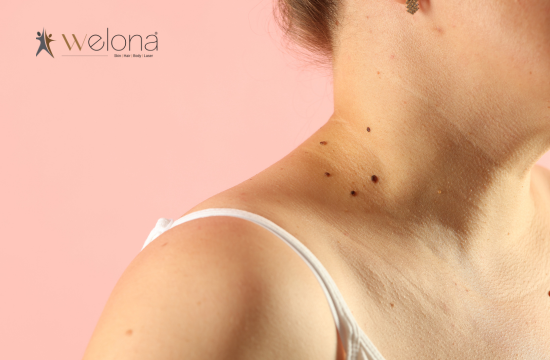
Have you recently noticed a small, soft growth on your neck or underarm? Perhaps it started as a tiny bump that you ignored, only to realize months later that it had grown slightly or begun catching on your clothes or jewelry.
If so, you’re not alone.
Skin tags are one of the most common benign skin growths seen by dermatologists. They can appear at almost any age but become increasingly common in adulthood. While they are usually harmless, many people choose to have them removed because they become irritated, bleed repeatedly, or simply affect their confidence. Before considering treatment, it’s important to understand what skin tags are, why they develop, and why removing them yourself is rarely a good idea.
What Are Skin Tags?
Skin tags, medically known as acrochordons, are small, soft growths that hang from the surface of the skin. They are made up of normal skin tissue, collagen fibers, tiny blood vessels, and connective tissue.
Research published in NCBI describes acrochordons (skin tags) as common benign skin growths associated with friction, obesity, ageing, insulin resistance, and metabolic syndrome.
Skin tags often appear:
- Flesh coloured
- Light brown
- Soft to touch
- Attached by a thin stalk
- Smooth or slightly wrinkled
They usually range from a few millimeters to around one centimeter, although larger skin tags can occasionally develop.
Where Do Skin Tags Usually Appear?
Skin tags tend to develop in areas where skin rubs against skin or clothing.
The most common locations include:
- Neck
- Underarms
- Eyelids
- Groin
- Under the breasts
- Upper chest
Some people develop only one or two skin tags, while others may notice multiple growths over time.
Why Do Skin Tags Develop?
Friction
Although the exact cause remains unknown, several factors can increase the likelihood of developing skin tags.
Repeated rubbing between skin folds or against clothing is thought to play an important role. This explains why skin tags frequently appear on the neck, underarms, and groin.
Age
Skin tags become more common with age. While they can occur in younger adults, they are more common after age 40.
Genetics
If close family members have multiple skin tags, you may be more likely to develop them as well. Genetics appears to influence how susceptible some people are.
Weight and Skin Folds
People who are overweight or have prominent skin folds may experience more friction, increasing the likelihood of skin tag formation.
Hormonal Changes
Hormonal fluctuations, particularly during pregnancy, may contribute to the development of skin tags. Many women notice new skin tags appearing during pregnancy, although some become smaller afterward.
Insulin Resistance
Research has shown that multiple skin tags may sometimes be associated with insulin resistance, obesity, metabolic syndrome, or Type 2 diabetes. This does not mean every skin tag indicates an underlying medical condition. However, individuals who suddenly develop numerous skin tags may benefit from a medical evaluation, especially if other risk factors are present.
Are Skin Tags Harmful?
In most cases, no. Skin tags are benign, meaning they are not cancerous and rarely pose a danger. Most remain unchanged for years.
However, they can become problematic if they:
- Catch on clothing or jewelry
- Bleed after repeated rubbing
- Become twisted, causing pain
- Affects self-confidence because of their appearance
Although skin tags themselves are harmless, not every skin growth is a skin tag. This is why it’s important to have new or unusual growths examined before attempting removal.
Skin Tags, Warts, and Moles: What’s the Difference?
Many people mistake skin tags for warts or moles, but they are different conditions that require different treatment approaches. Skin tags are soft, smooth, and usually attached by a thin stalk.
Warts tend to have a rough surface and are caused by the human papillomavirus (HPV). They may spread to other areas of the skin through direct contact.
Moles are collections of pigment-producing cells and are generally flat or slightly raised. While most moles are harmless, certain changes in a mole may require medical assessment. Because these conditions can appear similar, self-diagnosis is not always reliable.
Can Skin Tags Fall Off Naturally?
Sometimes. A skin tag may lose its blood supply if it twists on its stalk, leading to darkening, shrinkage, and eventual fall-off. However, this does not happen in most cases.
Should You Remove Skin Tags at Home?
The internet is full of advice suggesting dental floss, nail clippers, vinegar, toothpaste, or over-the-counter freezing products. Unfortunately, these methods carry risks.
Removing a skin tag without knowing exactly what it is may lead to:
- Bleeding
- Infection
- Scarring
- Incomplete removal
- Delayed diagnosis of another skin condition
This is especially important for growths located on the eyelids, face, or genital area. Professional removal is generally quicker, safer, and more precise.
How Do Dermatologists Remove Them?
The choice of treatment depends on the size, location, and number of skin tags.
Radiofrequency
One of the most commonly used methods. A controlled electrical current removes the skin tag while simultaneously sealing small blood vessels. The procedure is quick, precise, and usually leaves minimal scarring.
Cryotherapy
Small skin tags may be treated by freezing them with liquid nitrogen. Over the following days, the treated tissue gradually falls away.
Surgical Excision
Larger skin tags may be removed using sterile surgical instruments after local anesthesia. The procedure is simple and provides immediate removal.
Does Skin Tag Removal Hurt, and Will it Grow Back?
Depending on the treatment method and the size of the skin tag, your dermatologist may apply a local anesthetic before removal. Most procedures take only a few minutes. Patients can usually return to their normal daily activities immediately afterward.
Once an individual skin tag has been completely removed, it usually does not grow back. However, this does not prevent new skin tags from developing elsewhere in the future.
When Should You See a Dermatologist?
Although skin tags are usually harmless, it’s important to seek medical advice if you notice a skin growth that:
- Appears suddenly and grows rapidly
- Changes colour
- Bleeds repeatedly
- Becomes painful
- Has an irregular shape
- Looks different from your other skin growths
A dermatologist can determine whether it is truly a skin tag or another condition requiring different treatment.
Skin Tag Removal at Welona Chennai
At Welona Skin, Hair, Laser, Body Clinic, our dermatologist carefully examines every skin growth before treatment begins. Rather than removing growths based solely on appearance, dermatologists first confirm the diagnosis and recommend the safest removal method based on size, location, and characteristics.
Depending on your individual case, treatment may involve radiofrequency removal, electrocautery, cryotherapy, or minor surgical excision. The goal is safe removal with minimal discomfort, minimal scarring, and the reassurance that the growth has been properly evaluated. Book your consultation today!
To Wrap It Up
Skin tags are extremely common and, in most cases, completely harmless. A dermatologist can confirm whether the growth is truly a skin tag, recommend the most appropriate treatment, and remove it safely with minimal discomfort.
If a skin tag is becoming irritated, affecting your confidence, or you’re simply unsure whether it’s actually a skin tag, seeking professional advice is always the safest choice.
FAQ
Are skin tags contagious?
No. Unlike warts, skin tags are not caused by a virus and cannot spread from one person to another.
Is skin tag removal permanent?
The removed skin tag usually does not return, but new skin tags may develop in other areas over time.
Does removing a skin tag leave a scar?
When performed by an experienced dermatologist, skin tag removal usually heals with little to no scarring, though this depends on the growth’s size and location.
Is skin tag removal painful?
Most procedures are quick and cause minimal discomfort. Local anesthesia may be used for larger skin tags to make the treatment more comfortable.