

Growth Factor Concentrate (GFC) is a modern treatment for hair thinning. It uses purified growth factors from your own blood to help stimulate weak hair follicles. Unlike traditional PRP, GFC focuses on specific growth factors, resulting in more reliable outcomes. Doctors now often recommend GFC for early to moderate hair loss, especially when done with a clear treatment plan and under a dermatologist’s care.
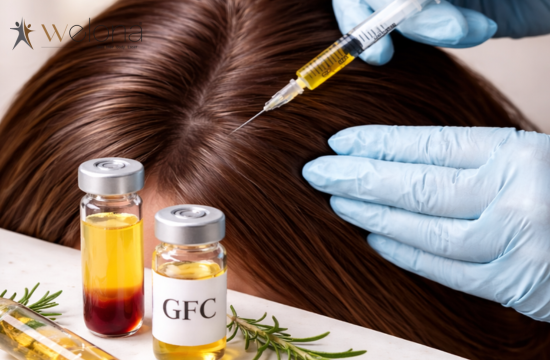
Let’s End The Hair Loss Myths
There is a lot of misinformation about hair loss. If you are losing hair, you have probably seen ads for “miracle” biotin gummies, laser combs, or herbal oils. Here is a medical fact: once a hair follicle shrinks because of genetics (Androgenetic Alopecia) or stress (Telogen Effluvium), no shampoo or vitamin gummy can restore it. Treating hair loss needs deeper, cellular-level solutions.
For the last decade, Platelet-Rich Plasma (PRP) has been the undisputed king of clinical hair restoration. However, medical technology evolves rapidly. Today, top-tier dermatologists are transitioning to a far more precise, comfortable, and effective protocol: Growth Factor Concentrate (GFC). GFC builds upon the foundation of PRP but enhances it through purification and standardisation, making results more consistent and targeted. This targeted delivery at the hair root promotes the stimulation of hair regrowth by providing these growth factors in a concentrated form.
At Welona Clinic in Chennai, we focus on treatments that are backed by science, not just trends. In this guide, we will explain how GFC works, why it is more effective than PRP, and what real results you can expect at our Chennai centers.
GFC: A Refined Approach to Follicle Stimulation
Hair follicles shrink gradually in most cases of patterned hair loss. This process, called miniaturisation, weakens strands and shortens the growth phase of the hair cycle.
Growth factors are important for cell communication. They signal hair follicles to grow, repair, and regenerate. PRP provided these growth factors using concentrated platelets, but GFC takes it a step further.
Rather than injecting all of the platelet-rich plasma, GFC separates and concentrates only the growth factors that help hair grow. This approach leads to:
- Higher biological activity
- Reduced variability between sessions
- Lower inflammatory load
- More targeted follicular signalling
In simpler terms, GFC delivers a cleaner and more standardised regenerative boost to weak hair follicles, helping them grow. Simply put, platelet concentration can vary from person to person. This means results can sometimes be inconsistent. GFC technology standardises growth factor concentration, which improves predictability. Patients who previously experienced modest improvement with PRP often notice more structured progression with GFC.
For people with early to moderate hair thinning, especially from androgenetic alopecia, GFC gives a strong boost to hair growth and is minimally invasive. It does not replace hair transplants if all follicles are lost, but it is a great option for those with weak but still active follicles.
GFC vs. PRP: The Clinical Verdict
| Clinical Metric | Traditional PRP | Growth Factor Concentrate (GFC) |
| Purity | Cellular (Contains platelets, some RBCs/WBCs) | Acellular (Pure growth factors only) |
| Pain Level | Moderate to High (due to RBCs/WBCs) | Virtually Pain-Free |
| Inflammation Risk | Moderate (WBCs trigger inflammation) | Negligible |
| Result Consistency | Highly variable based on daily health | Highly consistent and standardized |
| Onset of Action | Delayed (requires body to break down platelets) | Immediate (Growth factors are already activated) |
Procedure at Welona Skin, Hair, Laser, and Body Clinic in Chennai
At Welona, GFC treatment begins with a careful clinical evaluation to ensure it is right for you. It is not just a routine injection.
Step 1: Detailed Hair and Scalp Assessment
Each patient at Welona undergoes scalp mapping and follicle evaluation. This includes assessing:
- Pattern and stage of hair thinning
- Scalp health
- Miniaturisation extent
- Existing medical conditions
- Nutritional and hormonal factors
In this diagnostic phase, our dermatologists determine whether GFC alone is sufficient or whether combination therapy is recommended.
Step 2: Blood Collection and Processing
A small amount of blood is drawn under sterile conditions. This blood is processed using specialised centrifugation protocols that isolate platelets. From these platelets, purified growth factors are extracted and concentrated.
Unlike PRP, which reintroduces plasma containing platelets into the scalp, GFC separates and activates the growth factors before injection. This makes the treatment more precise and consistent.
Step 3: Targeted Scalp Injection
The scalp is cleaned thoroughly, and numbing may be applied to ensure comfort. The growth factor concentrate is then injected into carefully mapped areas of thinning.
We carefully plan the depth and injection site based on your hair and scalp condition. Each injection is placed to get the best possible stimulation for your hair follicles.
Step 4: Post-Treatment Care and Monitoring
We advise patients to use gentle scalp care for the next 24 hours. Mild tenderness may occur but usually resolves quickly.
More importantly, we schedule progress tracking. We monitor hair regrowth over weeks to assess reductions in shedding and improvements in density.
What Patients Typically Experience After The Treatment
Hair regrowth does not occur overnight. The process involves biological repair and cycle extension. Within a few weeks, many patients notice reduced hair fall. Over the next few months, hair strands appear thicker and more resilient. Density gradually improves as follicles re-enter active growth phases.
Since GFC works by helping your body regenerate, improvements can keep happening even after your last session as your scalp’s support systems become stronger.
Safety and Suitability
Since GFC uses the patient’s own biological material, the risk of allergic reaction is extremely low; however, expertise matters. Proper depth control, sterile handling, and correct patient selection are critical. GFC is most effective in individuals with active but weakened follicles. Completely dormant follicles may not respond.
For Indian skin and scalp types, experts consider GFC safe when performed by medical professionals under supervision.
A Structured, Long-Term Approach
At Welona, we rarely position GFC as a standalone miracle solution. We integrate it into a broader hair restoration plan that may include:
- Medical therapy
- Nutritional correction
- Lifestyle modification
- Combination regenerative sessions when indicated
This comprehensive approach increases the likelihood of meaningful and sustained improvement.
To Wrap It Up
GFC is not just another hair treatment trend. It reflects the evolution of regenerative dermatology toward precision and predictability. By refining growth factor delivery and reducing biological variability, GFC offers patients a structured path toward stronger, healthier hair without surgery.
For people with early to moderate hair thinning, GFC is a safe, effective, and minimally invasive option based on solid science.
[Book Your In-Depth Hair Analysis at Welona Today]
Visit our centers in Anna Nagar, T-Nagar, or Adyar for an expert skin assessment.
Call Us: 044 4011 4444
FAQ: GFC Hair Treatment
Is GFC better than PRP for hair loss?
Experts consider GFC a more refined version of PRP because it isolates and concentrates pure growth factors rather than injecting platelet-rich plasma as a whole. This approach often results in more consistent follicle stimulation and predictable outcomes. However, suitability depends on the individual’s stage of hair loss.
Does GFC permanently cure hair loss?
GFC does not permanently cure genetic hair loss. It strengthens and stimulates active follicles, slows progression, and improves density. You may need ongoing maintenance or supportive treatments for long-term management.
How many GFC sessions do I need?
Most patients require 3 to 4 sessions spaced a few weeks apart. The exact number depends on the severity of hair thinning and response to treatment.
When will I see results after GFC treatment?
Visible improvement in thickness and density typically develops gradually over 2 to 3 months as follicles respond to growth factor stimulation.
Is GFC painful?
Mild discomfort may occur during injections, but we use numbing techniques to improve comfort. Most patients tolerate the procedure well.
Is GFC safe?
Since GFC uses growth factors derived from the patient’s own blood, the risk of allergic reaction is extremely low. When a dermatologist supervises the procedure, experts consider it safe and minimally invasive.
Can GFC be combined with other hair treatments?
Yes. We often combine GFC with medical therapy, nutritional correction, or other regenerative treatments, depending on individual scalp evaluation.