

Moles are common skin growths that develop when pigment-producing cells (melanocytes) grow in clusters. Most moles are harmless and remain unchanged throughout life. Many people choose to remove moles for cosmetic reasons or because they become irritated by shaving, clothing, or jewelry. However, some moles can show changes that require prompt medical evaluation, as they may indicate skin cancer. Before removing any mole, it’s important to have it examined by a dermatologist to determine whether it is benign or needs further investigation. Treatment options include surgical excision, shave removal, laser treatment in selected cases, and biopsy when necessary.
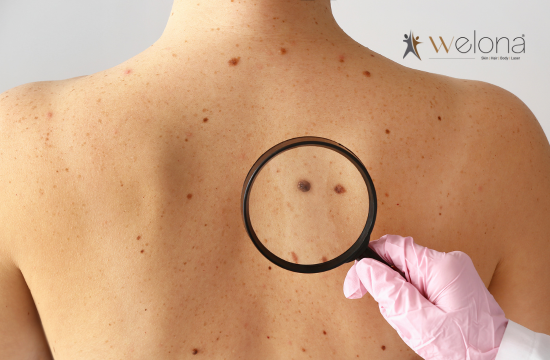
Almost everyone has at least one mole.
Some have only a few, while others have dozens scattered across their face and body. Most people rarely think about them until one starts changing, catches on clothing, or becomes something they notice every time they look in the mirror.
That’s usually when the questions begin.
“Should I remove it?”
“Is it dangerous?”
“Can it become cancerous?”
“Will mole removal leave a scar?”
These are important questions because not all moles should be treated in the same way. Many moles are completely harmless and are removed simply because they affect appearance or become uncomfortable. Others may need careful examination because changes in a mole can sometimes signal something more serious.
Understanding the difference can help you make an informed decision and, more importantly, know when it’s time to see a dermatologist.
What Is a Mole?
A mole, medically known as a melanocytic nevus, is a cluster of pigment-producing cells called melanocytes. Instead of spreading evenly throughout the skin, these cells group together to form a visible spot.
Moles can be:
- Brown
- Black
- Tan
- Skin coloured
- Slightly pink
They may be:
- Flat
- Raised
- Smooth
- Dome-shaped
- Hair-bearing
Some people are born with moles, while others develop them during childhood and early adulthood. It’s perfectly normal for new moles to appear until around the age of 30 to 40.
Why Do Moles Develop?
There isn’t a single cause. Several factors influence how many moles a person develops over a lifetime.
Genetics
Family history plays a significant role. If your parents have many moles, you’re more likely to develop them as well.
Sun Exposure
Ultraviolet (UV) radiation stimulates melanocytes. Repeated sun exposure may contribute to the development of new moles and increase changes in existing ones. This is one reason why dermatologists strongly recommend daily sunscreen use.
Hormonal Changes
Some people notice changes in their moles during:
- Pregnancy
- Puberty
- Adolescence
Hormonal fluctuations may cause existing moles to darken or become slightly larger.
When Is Mole Removal Cosmetic?
Most mole removals performed in dermatology clinics are cosmetic.
People commonly request removal because the mole:
- Appears on the face.
- Catches while shaving.
- Rubs against clothing or jewelry.
- Frequently becomes irritated.
- Affects their confidence.
If the mole appears completely benign after examination, removal is usually performed for comfort or aesthetic reasons.
When Should a Mole Be Checked by a Dermatologist?
Although most moles are harmless, some changes should never be ignored. Dermatologists often recommend using the ABCDE rule as a simple way to recognize suspicious moles.
- A – Asymmetry: One half of the mole doesn’t match the other.
- B – Border: The edges become irregular, blurred, or uneven.
- C – Color: The mole develops multiple colors such as black, brown, red, white, or blue.
- D – Diameter: The mole becomes larger, particularly if it exceeds about 6 millimeters.
- E – Evolving: The mole changes in size, shape, color, texture, or starts itching, bleeding, or crusting.
The E for Evolving is often considered the most important warning sign because stable moles rarely change significantly in adulthood. If you notice any of these features, don’t attempt mole removal yourself. Instead, arrange an examination with a dermatologist.
Why You Should Never Remove a Mole at Home
The American Academy of Dermatology recommends using the ABCDE rule to identify suspicious moles and advises that any changing or unusual mole should be evaluated by a dermatologist. Early assessment is important for detecting melanoma and other skin cancers.
Online videos often make mole removal look simple. Some recommend tying a thread around the mole. Others suggest apple cider vinegar, garlic, or over-the-counter mole removal products. These methods can be risky.
Removing a mole without knowing exactly what it is may:
- Delay the diagnosis of skin cancer.
- Cause infection.
- Lead to unnecessary bleeding.
- Leave a noticeable scar.
- Remove only part of the lesion.
Perhaps most importantly, if a suspicious mole is removed at home, valuable diagnostic tissue may be lost. Professional assessment should always come before treatment.
How Do Dermatologists Approach Mole Removal?
The treatment depends on why the mole is being removed and its appearance during examination.
Surgical Excision
If there is any concern about the mole, complete surgical removal is usually recommended. The dermatologist removes the mole along with a small margin of surrounding skin. If necessary, the tissue is sent to a laboratory for microscopic examination.
Shave Excision
Raised benign moles can often be removed using a shave technique. This procedure removes the raised portion of the mole while preserving as much surrounding skin as possible. Healing is usually straightforward, although the suitability depends on the type of mole.
Laser Removal
Laser treatment may be suitable for selected benign pigmented lesions. However, dermatologists generally avoid using lasers on suspicious moles because laser treatment destroys tissue that may otherwise need laboratory analysis. This is why an accurate diagnosis is always the first step.
Will Mole Removal Leave a Scar?
Any procedure that removes skin can leave a scar.
The appearance of the scar depends on several factors, including:
- The size of the mole.
- Its location.
- The removal technique.
- Your skin’s healing response.
Dermatologists choose the most appropriate technique to minimise scarring while ensuring complete and safe removal. Following aftercare instructions also plays an important role in achieving the best cosmetic result.
Can a Removed Mole Grow Back?
If a mole has been completely removed, it usually does not return. However, if a small number of pigment cells remain after certain cosmetic procedures, some pigmentation may reappear over time. This does not necessarily indicate cancer, but any recurrent pigmentation should be reviewed by a dermatologist.
Mole Removal at Welona Chennai
At Welona Skin, Hair, Laser & Body Clinic, every mole is carefully examined before treatment begins. Rather than removing all moles solely for cosmetic reasons, dermatologists first determine whether the lesion appears completely benign or requires further investigation.
Depending on the diagnosis, treatment may involve shave excision, surgical excision, or other appropriate techniques. If there is any suspicion of an abnormal mole, the priority is always accurate diagnosis and patient safety. The goal is not simply to remove a mole but to ensure that every patient receives the right treatment for the right reason.
To Wrap It Up
Most moles are a normal part of healthy skin and never cause problems. However, it’s important not to assume that every mole is harmless just because it’s been there for years.
Before considering cosmetic removal, let a dermatologist examine the mole to confirm the diagnosis and recommend the safest treatment. Whether your goal is to improve appearance or investigate a changing mole, the right diagnosis should always come first. Book your consultation today!
FAQs
Should every mole be removed?
No. Most moles are harmless and do not require treatment unless they change, become symptomatic, or are removed for cosmetic reasons.
Can a dermatologist tell if a mole is cancerous just by looking at it?
Dermatologists can often identify suspicious features during examination, sometimes with the help of a dermatoscope. If needed, they may recommend a biopsy or complete removal for laboratory analysis.
Is mole removal painful?
Most mole removal procedures are performed under local anesthesia, making the treatment comfortable for most patients.
Can laser remove all moles?
No. Laser treatment is only suitable for selected benign lesions. Suspicious moles should not be treated with a laser because tissue may need laboratory examination.
When should I worry about a mole?
You should seek medical advice if a mole changes in size, shape, color, starts bleeding, itching, crusting, or looks noticeably different from your other moles.